I’ve written about basic tick prevention and removal methods before. (Ditto for preventing mosquito bites.)
Since then, we’ve learned a little secret from the U.S. Military.
It’s called Permethrin spray!

Hubby and I now use Permethrin instead of DEET-based products to repel ticks and mosquitoes.
DEET is an excellent mosquito repellent, but it is a fairly poor tick repellent. We are inundated with so many DEET repellents because there are several huge corporations that manufacture hundreds of variations of DEET products. There is only one small company, Coulston Laboratory, that markets a handful of competitive tick repellent products for human use that contain 0.5% permethrin. Source
A Tick Repellent That’s Stronger Than DEET
We recently purchased yet another piece of land — to potentially build a log home on. (More on that here.)
As a result, Jim and I have been spending a significant amount of time deep in the middle of the woods walking the property lines and attempting to clear out a spot to put a house.
Yep, deep in the woods — where the ticks run rampant!
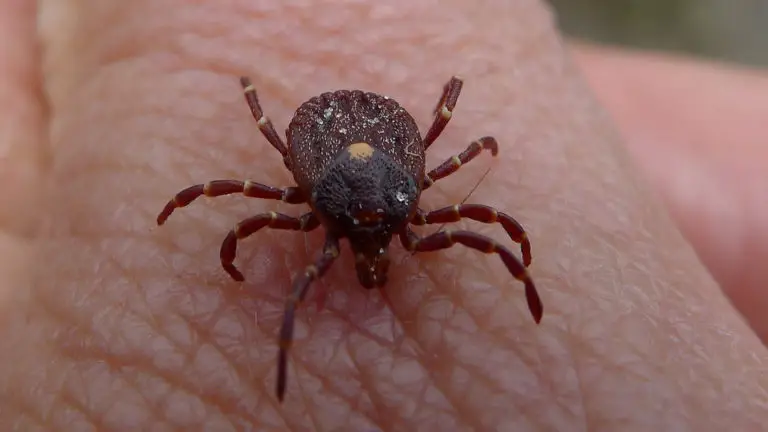
But this time, we asked a couple of people “in the know” (like land surveyors and land developers) about the best tick repellent for humans — because products with DEET just weren’t cutting it for us.
The answer we kept getting was: Permethrin spray.
It’s very potent. In fact, the guy at the Tractor Supply store called it a “nerve agent” that you should never get on your skin. (More about that below.)
Permethrin has been documented thoroughly by the Department of Defense and is now used regularly by the U.S. Military.

Following is everything we’ve learned firsthand about Permethrin tick spray, how it has worked for us so as a tick repellent & mosquito repellent, and where we buy it…
Facts About Permethrin
These are some of the interesting things I’ve learned about the chemical Permethrin:
- A synthetic pyrethroid insecticide rather than a true repellent, Permethrin works primarily by killing ticks on contact with the clothes and can provide high levels of protection against tick bites and mosquito bites.
- Permethrin spray causes no damage to any known cloth or synthetic fiber.
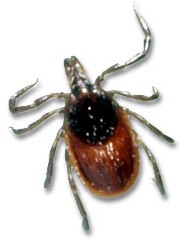
- Tests on ticks conducted in Massachusetts concluded that 100% protection was provided against the Deer tick (Ixodes Scapularis) which is the primary vector of Lyme disease in the Midwest and Northeast. The same outstanding results occurred when testing the Western Black Legged tick, Lone Star tick, American Dog tick, and Brown Dog tick.
- In tests, ticks that crossed only 10 inches of treated fabric fell from the uniform, later dying due to this limited exposure.
- Permethrin spray is applied to exterior clothing where it dries and bonds to the cloth fiber. This water-based formula is non-staining, odorless and has exceptional resistance to degradation by sunlight (UV), heat, and water.
- When placed on clothing, Permethrin spray will last 2 to 6 weeks (up to 1 year with special application). It will even last through weekly launderings.
- Permethrin is the best tick repellent for humans and the best form of prevention against tick-borne diseases — like Lyme Disease.
What If You Get Permethrin On Your Skin?
Permethrin has low mammalian toxicity, is poorly absorbed through the skin, and is rapidly inactivated by the body.
Skin reactions have been uncommon. In fact, Permethrin is virtually non-toxic to humans and no systemic effects have been reported. In EPA and FDA tests, it was uncommon to have any skin reddening, rash, or other irritation.
Although Permethrin is approved for skin application under certain circumstances (such as head lice), it is NOT applied to skin when used as an insect repellent.
The reason: Permethrin does not bond to skin. In fact, it is quickly deactivated by skin and turned into inactive compounds.
Because of this, Permethrin spray offers no repellent benefit on your skin. It is only effective when used as a clothing treatment.
Facts About DEET
These are some of the interesting things I’ve learned about the chemical DEET:
- DEET is the most effective, broad-spectrum repellent ever discovered.
- DEET comes in many different concentrations, with percentages as low as 5% or as high as 100%. In general, the higher the concentration the higher the protection, but the risk of negative health effects goes up, too.
- DEET needs to be applied regularly and can only work as it is evaporating
- DEET will repel ticks and decrease the chances of tick bite, but depending upon the concentration, it may not provide total protection against I. scapularis.
- Concentrations of DEET that might prevent tick attachment may not deter a tick from walking across the skin to unexposed and untreated areas.
 When applied to clothes, 30% and 20% DEET was found to be 92% and 86% effective against I. scapularis (deer ticks), respectively. But skin applications were reported to be only 75% to 87% effective against crawling ticks in a second study.
- DEET concentrations of 33% as provided in the 3M Ultrathon product (for use on skin) were chosen by the U.S. Military for its superior performance and high margin of safety.
- Most brand-name DEET-based products already have a DEET range from 15% to 33%. It is more effective to use lower concentrations of DEET with more frequent application than to assume the higher concentrations to be longer lasting. They are not.
Where To Buy Permethrin Spray For Clothing & Gear
Our land surveyor friend said to look for Permethrin “at the Co-op”. He said it comes in an aerosol can that you spray directly on your clothing and gear (but never on your skin).
The first place I thought to check was Tractor Supply — but they only had the kind for vegetation. In fact, the guy at Tractor Supply said they have a few different products for your yard with Permethrin in it, but they aren’t to be used on clothing and should remain far far away from your skin.
Not all Permethrin is blended for the purpose of bonding to fabric. Most Permethrin is agricultural which is for pest control on vegetation. Its design purpose is to stick to plants thus protecting the plants. Veterinary products are designed to adhere to animal skins/hair or premises and are not for fabric application. Some Permethrin is formulated for treatment of medical conditions such as head lice and scabies. The formulations are not interchangeable mostly because of solvents utilized. Always refer to manufacturers label and use instructions. Source
 So, I ran back home and hopped on the Internet where I found 2 places that sell cans of Permethrin spray for clothing and gear: Amazon and eBay. Amazon carries the Repel Permanone product and Sawyer Permethrin clothing spray.
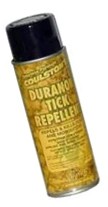 We decided to purchase a 3-pack of the Sawyer Duranon Tick Repellent online. Each aerosol can contains 6 ounces of .5% Permethrin and covers 2 outfits — shirts, pants, socks, shoes, and hats. (We found this to be accurate.)
Each of the above products are recommended by Kirby C. Stafford III, Ph.D. of The Connecticut Agricultural Experiment Station:
Several products contain 0.5% Permethrin (e.g. Duranon Tick Repellent, Repel Permanone, Cutter Outdoorsman Gear Guard, Permethrin Tick Repellent) — which is for use only on clothing or other fabrics such as mosquito netting or tents.
As Permethrin has become more popular as a tick repellent, we’ve started to see Permethrin spray available at sporting goods stores — including REI.
Our Unscientific Test: Permethrin vs. OFF With 30% DEET
To begin our experiment, Jim sprayed his jeans, short-sleeve shirt, socks, and shoes with Duranon (the Sawyer Permethrin spray) 2 hours prior to our trip — as instructed on the label. He made sure not to get any on his skin.
I sprayed my jeans, long-sleeve shirt, and shoes thoroughly with OFF a few minutes before we entered the woods.
So, after a 1-hour long walk in the woods, did we find any ticks on us???
We never found a single tick on Jim! Not one.
As soon as we got in the car, we found one on me (on my back, around the bra line). And a few hours later we found another one on me — in about the same location. That’s pretty typical.
When we only use a product with 30% DEET, we almost always find 2 to 4 ticks on each of us. And if we spend a lot of time in really thick woods (which we didn’t on this trip), then we usually find 5 to 10 on each of us. Yep, even with the DEET.
At this point, we are over the DEET products (when it comes to ticks anyway) and Permethrin spray now ranks #1 in our book — it’s definitely the best tick repellent for humans!
The Department of Defense system consists of both Permethrin treated clothing and DEET applied to skin. The use of one without the other will undermine the system and increase the risk of insect or tick bite. Source
Okay, so maybe we’ll still use 30% DEET on our skin and use the Permethrin on our clothing. With this combination, we may never see another tick in our lifetime!
 For More Information About Permethrin
Contact the National Pesticide Telecommunications Network. Their phone number is 800-858-7378. Hours: 9:30 a.m. to 7:30 p.m. EST or 6:30 a.m. to 4:30 p.m. PST.